Tuesday, February 26, 2013

University of Richmond


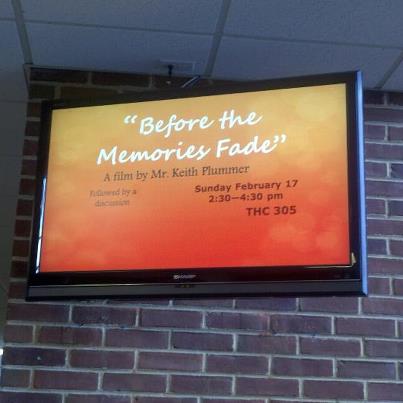
On February 17th I had the honor of screening my documentary at the University of Richmond for the Oliver Hill Scholars program for Black History Month. I had a very nice time and the audience was very receptive. 


After the screening there was a question and answer period which had great participation and response. I truly enjoy listening to the college students as they tell how they connected with the film.


This was one of the information screens the day of the event. It's always nice to see your name up in lights. : )

Saturday, February 2, 2013

Screening at the Univ. of Maryland


On Monday January 28th, the University of Maryland's Beyond the Classroom Living and Learning Program hosted, "An Evening with Filmmaker Keith B. Plummer," for its series on "People Power: Activism for Social Change." After the screening of the film students and other members of the audience asked the director a variety of questions relating to the film and the movement as a whole.  


Friday, January 18, 2013

Before the Memories Fade, ATL Screening 1/16/13


We had a great night screening in Atlanta! Nothing but complements streamed from the audience during the Q&A.  Two of the featured foot soldiers came out to see it and one even teared up. As a director it always makes you feel good when your film connects with the audience.


Top billing on the marquee is always nice! Thank you Plaza Theatre staff. Atlanta! See you soon!


Tuesday, December 18, 2012

Screening Set for Atlanta January 16

Before the Memories Fade: Voices from the Civil Rights Movement, will begin it's 2013 screening tour Wednesday January 16th in Atlanta. The 107 minute documentary will be shown at the Plaza Theatre, with the start time set for 7pm.
Photo: Director Keith B. Plummer and Rep. Eleanor Holmes Norton after the Washington, D.C. premier.

"This story has been told 100 different ways but you found a new way to tell it. This was just wonderful! Wonderful! You found a way to capture who we were."  Rep. Eleanor Holmes Norton


Saturday, September 8, 2012

National Press Club Date Scheduled

We will be holding a news conference on the film, Before the Memories Fade: Voices from the Civil Rights Movement, September 25th at noon at the National Press Club.

This will be the first national publicity for the movie. What a nice venue to begin our journey.

Personally this is a huge event for me considering the 18 plus years I spent covering various news conferences as a cameraman for a Washington D.C. news bureau.

It will be different being on the other side of those cameras and microphones while being the focus of the national news media.

I'm looking forward to it.


Fox 5 TV Appearance Lined Up

I am scheduled to appear on the Fox 5 Morning Show on September 26th with host Allison Seymour. It will be great to get the word out about the movie and have fun with some of my old D.C. news friends.

My segment is scheduled to go on at 9:15 so set your recorders if you can't watch it live.

Projection Tests


We're on countdown. 14 business days until the Premier screening. Here testing the Blu Ray projection on the wall. It's always very interesting to see your hard work so large in scale after looking at it for years on an editing monitor or 50 inch plasma.

We have a few more checks but it's looking good. Can't wait to hear what you think.

Premier Screening in D.C. Sept. 27th

We are happy to announce the Premier Screening of Before the Memories Fade: Voices from the Civil Rights Movement, on September 27, 2012, in Washington, DC.  The documentary feature film will screen at 8:00 pm at the newly remodeled Avalon Theatre, 5505 Connecticut Avenue, N.W., Washington, DC 20015.

After the screening there will be an opportunity for Q&A with the director and several of the movie and movement participants.

Running Time: 1 hour and 47 minutes
Suggested age: 13 years and older

Director: Keith B. Plummer
Plumgood Productions

Wednesday, April 28, 2010

Before The Memories Fade: William T. Coleman

It was a rainy morning in Lexington, Kentucky, on April 8, but the sun shone long enough for me to have a great shoot with the Honorable William T. Coleman, Jr., Esq. Mr. Coleman was in town this past Thursday to speak at the University of Kentucky College of Law.

For those of you who have never heard of Mr. Coleman, let's just say his work had a hand in some some really big legal aspects of the movement. Mr. Coleman worked closely with Thurgood Marshall on many cases, including as one of the lead strategists and coauthor of the legal brief in Brown v. Board of Education (1954). Brown was one of the landmark civil rights cases dealing with racial segregation in which the U.S. Supreme Court held racial segregation in public schools to be unconstitutional.

Mr. Coleman shared some very interesting stories of his life and his time in the movement. His stories were intriguing and after hearing his personal insights, I couldn't help but leave the interview questioning the truth of some of what we were taught about situations that occurred in American history.


Wednesday, November 4, 2009

Before the Memories Fade: Stoney Cooks

I had a very interesting talk with Mr. Cooks on October 9th in Washington, D.C. We talked about what led him to join the movement and travel down south while he was enrolled in college in Indiana. He told me that while driving in the south they decided to stop for food: "We should have known better but it all worked out."

A lot of the interview revolved around the strategic side of the protests, marches, and sit-ins. Mr. Cooks really wanted to get across that events were strategized and planned. "We didn't just get arrested to get arrested. Everyone couldn't get arrested at the same time. Someone had to keep track of who got arrested and where they were. We also needed to be able to continue the protests."

One note that I have to leave you with comes from the pre-interview conversation Mr. Cooks and I had about Rosa Parks. While talking about researching the movement, Mr. Cooks stated that the internet is great but people often stop at the little snippets they read on wikipedia and usually don't dig further. For example, he commented: "The biggest miscarriage of justice to sister Rosa Parks was the belief that she was just tired and didn't want to move out of her seat." Rosa Parks was not simply tired. She was a community activist who had earlier spent time with Dr. King and others at the Highlander Center in Tennessee, a meeting place where activists frequently gathered to share strategies for nonviolent protest (http://www.highlandercenter.org/). Ms. Parks made a conscious decision not to give up her seat because of racial injustice.

Monday, October 19, 2009

Before the Memories Fade: Dr. Dorothy Height

I'm typing this entry with a big smile because on Thursday October 8th, I interviewed Dr. Dorothy Height for the film. Dr. Height! If you guys don't know who she is, you need to read up on her quickly. Dr. Height is a 97 year young wealth of knowledge on women's rights and civil rights. Dr. Height is respected world wide and has many honorary doctorates from universities here in the states. She took over the leadership of the National Counsel for Negro Women after Mary McLeod Bethune. That is history people and it was a honor to get her perspective on the movement!!

What I decided to focus on in our conversation was a little known effort in the movement started by Dr. Height and Polly Cowan in the Spring of 1964. It was called "Wednesdays in Mississippi." The idea was to send interracial and interfaith teams of northern women to Mississippi on Tuesday and return on Thursday, having spent all day Wednesday talking with and reaching out to the women of the south. Dr. Height said that black women from the north would meet with black women of the south, while the white women from the north would meet with white women of the south. The northern women would all meet up later and discuss ways in which thy could help their fellow sisters.

We did discuss many other movement related subjects, but I'm going to let you hear about them in the movie.

It was a great interview, and Dr. Height was, as I expected, strong, smart, and delightful.

For more on Dr. Dorothy Height go to: http://www.ncnw.org/ and please web search her name and learn more.

Saturday, October 3, 2009

Before the Memories Fade: Fox Artists

Today I met with and signed a very talented and young husband and wife team of sketch artists to work on the documentary. Justin and Lauren Fox of Lexington, Kentucky, have impressed me with their diffrent styles of rendering images. I will be incorporating several of their pieces in the film. I believe their sketches will add a different element to the film's look.

Both Justin and Lauren will be designing the promotional poster for the film. I gave them a concept but I'm going to let them do their magic. I can't wait to see the result. Their ability is a reminder that it's not the size of the company but the talent in it.

For more information on Justin and Lauren go to: http://www.foxartists.com/

Tuesday, September 29, 2009

Before the Memories Fade: Derrill E. Holly

Mr. Holly was my last interview of the day on September 18th. I met with him at his home in Maryland. Mr. Holly and I became friends years ago when I worked as the Chief Photographer for Hearst-Argyle Television's Washington Bureau and he was a national radio reporter for the Associated Press.

After we caught up a little, Mr. Holly told me that in the 60s he lived in Cleveland, Ohio, and was in high school when he heard Dr. King speak outside of a department store to raise money for the movement. "Many of the leaders would come . . . together and speak at different churches and raise money to go back south for the movement."

We also talked about life as a Black northerner in the 60s. He said you didn't have a problem getting a seat on a bus, but if you went to certain neighborhoods, you wouldn't "be surprised if you got stopped and asked what you were doing in that neighborhood."

We also talked about the day Dr. King was assassinated and the riots that ensued afterwards. He said that his neighborhood was crazy; "you could hear the glass breaking in the corner stores." Then we talked about how those same riots influenced how reporters would be selected to cover those events. Many news outlets were not able to get an accurate story because they did not have reporters of color to get the inside story. It either wasn't safe for non ethnic reporters or no one would talk to them. The news world started to realize it too needed to integrate.

It was a good interview and great to see an old friend.

Wednesday, September 23, 2009

Before the Memories Fade: Ruby Gary

I interviewed Mrs. Gary at her home in Washington, D.C., on September 18th. Mrs. Gary's contributions to the movement were in the form of sign-making and marching outside of the White House in protest. She described her routine as going to work, returning home, working on signs, protesting for awhile, going home to bed, and starting it all over the next day.

Mrs. Gary had an interesting story about the day of the March on Washington. She and other foot soldiers had been preparing for the march when she began to feel ill. As the time to march grew closer, she began feeling more sick. She eventually became so ill that she had to go to the hospital. There she was diagnosed with appendicitis and had to have her appendix removed, causing her to miss the march. "I was one mad sister" after the drugs wore off, she said.

Before the Memories Fade: Julia H. James

I started September 18th with an interview in Alexandria, Virginia, of Mrs. Julia James. She was a student at North Carolina A&T in the early 60's.

Like many foot soldiers in the movement, Mrs. James never really told people of her involvement. "I don't think it's much compared to most," Mrs. James said, but as I listened, her story became more intriguing.

Mrs. James participated in sit-ins in Greensboro, North Carolina, right after the initial sit-ins at the Woolworths. She even went to school with and knew one of the original 4 who participated in the first sit-in in Greensboro! We also talked about her arrest while particpating in a sit-in.

My interview of Mrs. James ended with her relaying memories from the March on Washington, one of the best days of her life, she said.

Tuesday, September 22, 2009

Before the Memories Fade: LaVerne B. Rogers

My second interview on September 17th was with Mrs. LaVerne B. Rodgers, a Washington, D.C. resident. Mrs. Rodgers talked about her attendance at the March on Washington.

Mrs. Rodgers recalls as a 10-year-old walking with a group of friends to "listen to the man that was on TV who was being beaten." When describing her day at the Lincoln Memorial she smiled, then talked about being surrounded by all of the people. "It was just amazing to talk with all kinds of people from all over with different kinds of drawls, telling what they had gone through."

Mrs. Rodgers was not able to get close to the Memorial but, like many other people, she listened to the speakers on a transistor radio. The experiences of that day are still very fond memories for her.

Before the Memories Fade: Rep. John Lewis

Today, September the 17th, I met with one of the most storied 60's Civil Rights icons, Congressman John Lewis of Georgia. Representative Lewis was kind enough to meet with me during his extremely busy Capitol Hill schedule. Given that this Fall session has been jam- packed, the time was well appreciated. I will take it on faith that by now you have read up on the movement and know that Rep. Lewis was in the front of the battle lines on the fight to end segregation.

The interview was held in his office where I saw several photographs and reminders of his ties to the movement. The Congressman and I had a wonderful interview and I truly enjoyed hearing the stories from him. Rep Lewis talked about the importance of the Freedom Rides and what it was like to be on them. He also told what it was like the day of the March on Washington. I learned that the ten speakers met with congressmen on Capitol Hill and then marched with the crowd to the Lincoln Memorial. Rep. Lewis spoke 6th in front of the massive crowd of people gathered at the Lincoln Memorial on that historic day. After the march, the speakers met with President John F. Kennedy.

Rep. Lewis also talked about his belief in non-violence as a lifestyle and why he joined the movement. We also talked about the physical abuse he took, including his beating during "Bloody Sunday."

I could have questioned, talked, and listened to the Congressman for hours, but the buzzers were sounding as several votes were being called on the House floor so the Congressman had to leave.

It's so great to here stories of these events that helped to change the course of American history!

For more information on Rep. John Lewis, go to http://johnlewis.house.gov/ or search his name on the Internet.

Saturday, August 15, 2009

Before the Memories Fade: Rep. Eleanor Holmes Norton

I caught up with Congresswoman Norton in her Capitol Hill office on August 13th. Even though Congress is out of session, Rep. Norton's office was bustling and her staffers were hard at work. I'd like to again thank her for taking time out of her busy schedule for my interview. This was a fun interview for me because growing up in the Washington, D.C., area I have watched her fight to become D.C's House Representative. She was also one of my last television news interviews before I started doing production full time.

I must say I was very happy with the shot that I set up for Rep. Norton's interview. It's a very pretty shot with beautiful colors and she looks good in it. The interview itself was very interesting and even became emotional at one point when she talked about her time in Jackson, Mississippi. She was shown around by Medgar Evars, hours before he was assassinated. "It is impossible to recount what I felt."

On what she thought about the youthful participation in the movement, she said: "Sometimes you have to be a little foolish to do some of the things we did by facing guns with non-violence, but change in our society is far more often propelled by young people with a new vision for our country."

Here's a fun fact for you: In the 60s, Rep. Norton sported an extremely large afro, which, looking back at photos, was very stylish and cool.

To find out more about Rep. Eleanor Holmes Norton: http://www.norton.house.gov/

Saturday, August 8, 2009

Before the Memories Fade: Bob Adelman

While taking a short vacation in Florida, I set up an interview with Bob Adelman, photographer and social activist known for his historic coverage of the Civil Rights Movement. The interview was held in Bob's Miami home on August 6th.

Upon entering his house I saw some of his fantastic work displayed on the walls. All I can say is "Wow!" On a personal level, Bob was very easy going and had a lot of good stories to tell.

During the interview, Bob told me how he got interested in the movement and why he began to travel and shoot photographs, many times while in harms way. He also explained why he believes he became trusted by many people in the movement to deliver the truth through photography.

I think the interview went well and Bob provided some great insight into the movement. I had a great time and hope to get back down to Miami and talk with Bob again.

At the end of the interview Bob autographed one of his many books for me. Thanks again, Bob!

If you'd like more information on Bob Adelman and to see some of his work, visit: http://www.bobadelman.net/